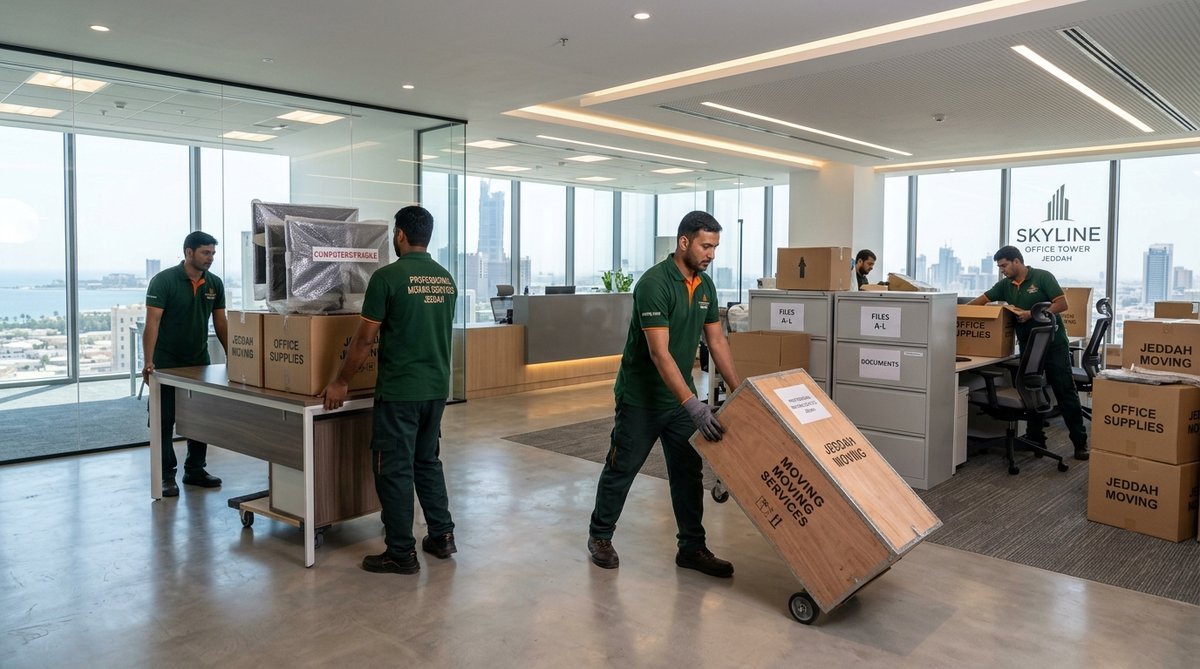
Professional offices need more than a truck
Al Rawdah is a well-known residential and commercial district of Jeddah, and many small and medium professional offices work there: engineering and consulting offices, accountants, law offices, clinics, real-estate and insurance agencies, and branch offices of companies. They sit in older apartment buildings, ground-floor units and blocks whose entrances face busy streets. What sets these offices apart is that their most valuable contents are not furniture: they are drawings, client files, specialised printers and years of archives. Office furniture moving in Jeddah for this kind of client has to protect those things first.
This page looks at professional offices in Al Rawdah: how we move drawings, archives and large equipment, how we cope with street-level entrances and older buildings, and how a move can be staged so the office never stops entirely. We avoid repeating what is said for other districts and concentrate on what these offices need.
The kinds of office we move in Al Rawdah
- Engineering and consultancy offices: large drawings, plotters, powerful workstations and drafting tables.
- Accounting and audit offices: client files, annual archives, computers and cabinets.
- Law offices: case files, reference libraries and confidential records.
- Small clinics and medical centres: reception furniture, patient files and particular equipment.
- Agencies for property, insurance and services: reception furniture, signs and display equipment.
- Corporate branch offices: several workstations, meeting rooms and archives.
Drawings and plans: never folded, never loaded
Engineering drawings need their own handling. A plan that has been folded, has a torn edge or has got wet is hard to repair, and an original that is hand-drawn or signed may not be reproducible. We keep rolled drawings in numbered tubes by project name, and flat drawings in drawers or rigid folders carried horizontally. We never stack weight on them. The most sensitive originals stay with the project lead, who carries them or rides along. It is a simple habit that avoids expensive errors.
| Document type | How it travels | Why |
|---|---|---|
| Rolled drawings | Numbered tubes carried horizontally | Prevents creasing and bending |
| Flat drawings | Drawers or rigid folders, no weight on top | Protects edges and signatures |
| Client files | Numbered boxes by name or year | Makes searching easy after the move |
| Confidential files | Sealed boxes accompanied by a responsible person | Prevents loss and protects confidentiality |
| Reference books and journals | Small boxes, not overloaded | Stops boxes collapsing and spines being damaged |
Ground-floor offices and entrances on busy streets
Many offices in the district are on the ground floor or in buildings whose doors open on active streets or markets, which makes truck parking a delicate point. A close space may not exist or may be occupied. So we plan with you: a time when traffic is lighter, a waiting place that blocks as little as possible, and quick loading so the truck stays in front of the door for the shortest time. It also helps to stage large items near the door before the truck arrives.
- Pick a time when the street outside your office is quieter.
- Tell us if there is a reserved space or an agreement with neighbours for temporary parking.
- Stage large items near the entrance before the truck arrives.
- Write department names on boxes so loading can be sorted quickly.
- Have one person stay at the door to supervise movement in and out.
Older buildings and small lifts
Some buildings in older districts have narrow entrances, stairs that cannot take large items and small lifts with limited capacity. This affects how steel cabinets and big desks are moved: they may need complete dismantling or lifting with special equipment. Before the appointment, tell us the floor, stair width, lift capacity and the largest item that has to pass, so we bring the right crew and equipment and avoid surprises on the day.
Large printers and plan scanners
Plotters, large-format scanners and heavy copiers are sensitive and expensive. Before moving, ink is removed and moving parts are secured as the manufacturer instructs; the machine is wrapped and carried upright. We recommend that the machine's technician or agent recalibrates it afterwards. We look after safe transport and correct positioning, not machine settings.
Staging the move so the office keeps working
Professional offices often cannot stop completely. We therefore suggest dividing the move: in phase one, we carry the old archive, areas that are rarely used and surplus furniture; in phase two, the core workstations and reception equipment. Part of the team keeps working in the old office until the last moment while the rest start in the new one. It is especially useful for offices with fixed client appointments.
Privacy and chain of custody for sensitive files
Law, accounting and clinic offices handle information that no unauthorised person may see. We recommend that a named person on your side takes charge of sensitive boxes at departure and signs for them at the new office, and that these boxes are closed and sealed before loading. Our role is physical transport only: we do not open boxes or read what is inside. A simple sheet recording each box number, who handed it over and who received it makes sure no box is ever without an owner during the journey.
What deserves to be moved
A move is a chance to review what you have. Some furniture bought years ago may not suit the new premises in size or style, and some is worn out. Before paying to move everything, ask: will this cabinet hold our new files? does this desk fit the new rooms? can what we do not need be sold or donated? During the survey we help judge the condition of items, and tell you what is worth moving from its sturdiness and dimensions.
Choosing the day and hour
Busy districts have rush hours in the morning and evening and quieter periods at other times, depending on the shops and offices around. Check the pattern near your office and choose the best time, and tell your neighbours in the building about the move in advance. The earlier in the day we start, the more time we have to finish reassembly the same day.
Setting up the new office
At the new site we first compare the plan with reality: where are the doors, power outlets and network points, and is the floor clean and dry. We then place desks, partitions and chairs, assemble cabinets and place equipment, leaving final connection and start-up to your IT person. At the end we walk through each room with you against the inventory and note any remarks. If drawings and files need fixed places, we help arrange cabinets and drawers as agreed.
Measure before you buy new furniture
Some owners buy new furniture with the move and then find that it will not pass the door or fit the lift. Before buying, measure door widths and heights, stair width and lift size, and tell us so we can say whether the item arrives flat-packed or must be assembled in the room. We can assemble ready-to-assemble pieces at the new office from the instruction sheet, once you tell us the type of piece and the number of parts.
Where this fits with our other services
For residential moves in the district see furniture moving in Al Rawdah. If your office or archive needs temporary space, read furniture storage for Al Rawdah residents. The general service is described at office and corporate moving in Jeddah, and if you are comparing districts, our office relocation in Al Shati page covers the waterfront.
Mistakes seen in professional office moves
- Putting drawings in ordinary boxes and folding them to fit.
- Not numbering file boxes, so time is lost searching after the move.
- Ignoring where the truck can stop at the entrance.
- Not measuring the new office door and lift before buying furniture.
- Moving a printer without removing ink.
- Telling clients about the new address too late.
What affects the cost of the move
We do not state fixed prices because every office differs. The main factors are the number of workstations, the size of the archive, large printers and equipment, the floor and lift capacity, the difficulty of access from the street, the number of phases, whether furniture must be dismantled and reassembled, the distance between the two offices and any temporary storage. The more exact your numbers, the closer our estimate.
Checklist before the move
- Count workstations, cabinets and large printers.
- Number file and drawing boxes by project or client.
- Measure doors and lifts at the new office and the largest item that must pass.
- Agree where the truck will stop and a quiet time to move.
- Decide who watches over confidential files during the move.
- Prepare network and electricity at the new office ahead of the date.
For a plan that suits your office in Al Rawdah, call or message us on WhatsApp with the type of practice, workstations, archive size, large equipment and preferred date. We will suggest a survey or work from your description and photographs.
In short, professional offices depend on the information and equipment they hold more than on furniture, so a good move protects those assets first and arranges furniture second. With a clear inventory, careful numbering and well-planned phases, your office gets back to work quickly at the new address, and every file, drawing and machine is where you expect it to be.
Al Rawdah Office Moves: Questions and Answers
Do you move engineering drawings and large plan rolls?
Yes. Rolled drawings go into numbered tubes by project and flat drawings travel horizontally in drawers or rigid folders. Nothing is folded or loaded with weight. We suggest your project lead carries or accompanies the key originals.
Our office is on a ground floor with the entrance on a busy street. How do you handle parking?
We agree a temporary stopping place and a quieter time with you, and plan loading so that the truck is in front of the entrance for as short a time as possible.
Can you move large plotters, copiers and scanners?
Yes, after ink is removed and moving parts are secured and wrapped. We suggest the machine's technician recalibrates and restarts it.
Do you dismantle bookcases and archive shelving?
We dismantle shelving and bookcases that come apart, number the panels and reassemble them according to the new layout.
Can the move be split over two days so the office does not stop?
Yes. Day one carries the archive and the least-used areas; day two moves the core workstations, so work continues with minimum disruption.
Can you combine an office move with a home move?
Yes. We coordinate two loads on the same day or on consecutive days to fit your schedule.