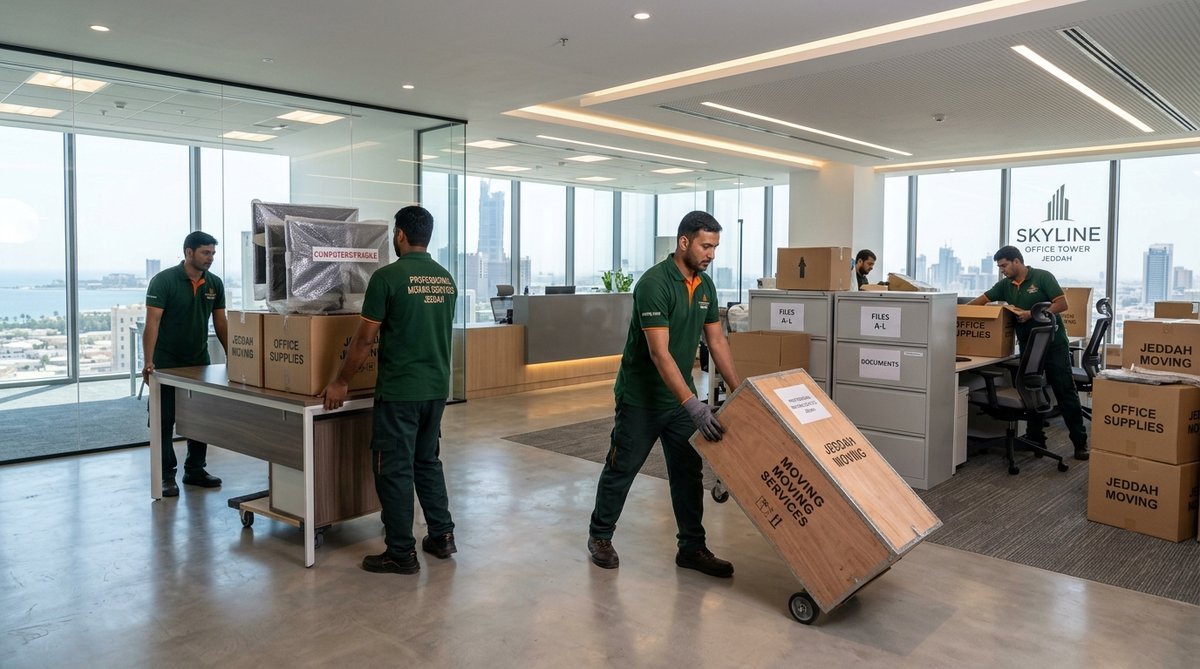
Moving a business without stopping the business
Al Shati sits near the Corniche and has a varied building stock. Small companies, clinics, consultancies, shop back-offices and administrative branches work from towers and commercial buildings here. The bigger the office, the more a relocation becomes a project: every day that work cannot resume costs time and customers. That is why office furniture moving in Jeddah differs from a household move. Time, equipment wiring, files and computers come before everything else.
This page explains how we handle office moves in Al Shati, from survey and scheduling to dismantling workstations, protecting equipment, moving archives and setting up the new office, and what you can prepare in advance to shorten the process. It is written for the office manager, operations lead or small business owner who is organising the move personally.
How an office move differs from a house move
- Time matters more than space: each hour of downtime is lost work, so the process is built to cut the days of interruption.
- Equipment and wiring: computers, printers, network and phones need numbering and a record of connections before they come apart.
- Paper and files: sensitive documents must not be mixed, lost or damaged.
- Building rules: service lifts, fixed hours, worker permits and floor protection.
- Layout-led placement: every desk goes where the new plan says, not in the order it comes off the truck.
Survey and layout plan before any dismantling
We begin with a survey of the current office, or a detailed description and photographs when time is short. We note the number of workstations, the type of desks and whether they are fitted or free-standing, chairs, cabinets, computers, printers, meeting rooms and reception. If you have a plan of the new office we ask for it, then label each workstation with its place on that plan so the crew knows exactly where to put every item on arrival.
- Inventory: a list of all items, their departments and current positions.
- New layout: a rough drawing of desk, room and reception placement.
- Labelling: a label on every item with department, workstation number and destination.
- Scheduling: choose the day and hours together with building management.
- Execution: dismantle, move and reassemble, then a final walk-through with your manager.
After-hours and weekend moves
The best time for an office move is usually after work ends or on the weekly day off, so staff return to desks that are ready. We suggest dismantling and loading in the evening and reassembly early the next morning before work starts, or splitting a large office over two consecutive nights. Building policies vary: some forbid moving after a certain hour, others assign a service lift for set times. Please call management before fixing the final date.
Computers and network equipment: keeping the connections straight
What eats the most time after a move is reconnecting equipment. So we photograph the back of every machine and its cables, put matching labels on the cable and the port, and keep each device with its accessories in a numbered box or bag. We recommend that your IT person or provider backs up data, shuts down servers and restarts the network; we do the physical moving and placing, not software. Sensitive equipment such as small servers and large monitors travels in a safe position with nothing stacked on it.
| Office item | Preparation | At the new office |
|---|---|---|
| Computers and monitors | Numbering, photographs of wiring, foam wrapping | Placed on workstations by number before cabling |
| Printers and scanners | Remove ink and paper, secure covers | Left to settle before switching on |
| Fitted desks and partitions | Dismantle and number panels and joints | Reassembled according to the new layout |
| Steel cabinets and archive units | Empty or lock drawers, lift with proper equipment | Placed on a strong floor away from damp |
| Office and reception chairs | Protective covers, grouped by department | Distributed to each room by count |
Paper files and archives
Paper is the hardest thing to repair after a mistake. We recommend arranging files in numbered boxes by department and date order, with a short list of contents on the lid and on a separate sheet. We never overfill a box, and we protect boxes from damp. If some files are confidential, they should travel in sealed boxes that one of your managers carries or accompanies.
Lifts and building management
Many commercial buildings and towers in Al Shati regulate moving through a management office. It may ask for advance notice, a small fee, or protection for floors and lift walls. We tell you what to prepare from experience, but the actual rules come from management. Ask about permitted hours, the number of service lifts, the largest item size allowed, and whether a crane or window lowering is permitted if the lift cannot take an item.
Reception and meeting rooms: the first impression
The first thing a client sees at the new office is reception and the meeting room, so we give them priority. Large meeting tables are often made of heavy panels with metal legs. We dismantle them, number the joints, protect the glossy surface, and reassemble them in position before any equipment is connected. Large screens and sound systems travel with special protection and are set up after the furniture, so nothing rubs against them while other pieces come in. If someone responsible for décor or branding can be at the new site, it helps to see each piece in the right place.
Clinics, consultancies and small shops
Not every office mover in Al Shati is a company. Clinics, consulting practices and small showrooms have their own needs: sensitive equipment, client or patient records that must not be lost, and reception furniture with a particular look. We plan so that delicate equipment is loaded last and unloaded first, files stay in closed boxes, and set-up starts with the areas the business needs first so reception can resume quickly. We do not move any specialised medical device without clear instructions from the party responsible for it.
Temporary storage between two offices
The new office may not be ready when the old lease ends, or it may be smaller, leaving surplus pieces. Furniture can then be stored for a limited time and brought back when the new space is ready. We arrange the inventory so items return by department, saving you from redistributing everything from scratch. For coastal storage conditions see furniture storage in Al Shati.
The moving day, hour by hour
Here is a general picture of a medium-sized office move; it varies with size and building rules. In the first hours the crew arrives, reviews the inventory with you and protects the corridors and lift. Then one team dismantles desks and heavy partitions while another wraps equipment and boxes files. The truck is loaded in the order of unloading, so what is needed first at the new office comes off first. On arrival, we unload and assemble according to the plan, and at the end you review the equipment with us and sign for receipt. Large offices can be split across two nights.
Mistakes that delay getting back to work
- Not booking the lift, which delays unloading and wastes hours.
- Moving equipment without numbering or photographing connections.
- No layout for the new office, so desks are moved more than once.
- Mixing departments' files in unnumbered boxes.
- Leaving power, network and air-conditioning set-up at the new office to moving day.
- Not telling clients and suppliers about the new address and the downtime.
Keeping staff and clients informed
Part of a successful move is communication. Tell staff the moving days and what is expected of them, such as clearing personal items and packing bags, and tell clients and suppliers the new address and the expected interruption. Name one person on your side as our point of contact for any question on the day. It saves a great deal of time and avoids confusion.
What affects the cost of an office move
We do not publish fixed prices because every office is different. The main factors are the number of workstations, the volume of furniture and equipment, the floor and the lift and building rules, after-hours timing, the quantity of archives, any dismantling and reassembly, the distance between the two offices, and any temporary storage. An accurate count of items lets us give you an estimate closer to reality.
A checklist for the office manager
- Book the lift and confirm hours with the managers of both buildings.
- Prepare a simple layout of the new office and mark workstation positions.
- Arrange data backups the day before.
- Ask staff to clear their desks of personal items.
- Prepare and number file boxes by department.
- Tell clients and suppliers the new address.
- Check that power, network and air-conditioning are ready at the new office.
If you run an office or small business in Al Shati and plan to move, call or message us on WhatsApp with your headcount, workstations, equipment and preferred date, and we will arrange a survey and a plan. For the general service, see office and corporate moving in Jeddah, and for residential moves in the district, furniture moving in Al Shati.
A successful office move is judged not by how fast the truck is loaded but by how quickly your team is back at work as normal. When an organised team handles dismantling, numbering, wrapping, scheduling and reassembly against a clear plan, errors fall, downtime shrinks, and staff find their desks ready on the first working day at the new address.
Office Moving in Al Shati: Common Questions
Can the move happen after office hours or on a weekend?
Yes. We can agree an evening or day-off slot subject to building policy, which keeps downtime short. Please book the lift with building management in advance.
How do you handle computers, printers and network cabling?
We number devices and cables and photograph the wiring before disconnecting. Equipment is wrapped for transit. We recommend your IT person handles data and network start-up; we handle the physical move and placement.
Do you move paper files and archives?
Yes. Files go into numbered boxes by department and sequence, with contents recorded for each box, and are kept away from damp.
Do you dismantle and reassemble partitions and workstations?
We dismantle fitted desks and partitions that come apart, number them and reassemble them at the new office according to your layout.
Is a permit from building management required?
Many buildings require a lift booking, a worker access permit or corridor protection. Ask management early and tell us the rules so we bring the right materials.
Can you move steel cabinets and heavy office chairs?
Yes, with suitable equipment and enough crew. Tell us the approximate weight and the floor so we can bring the right lifting tools.